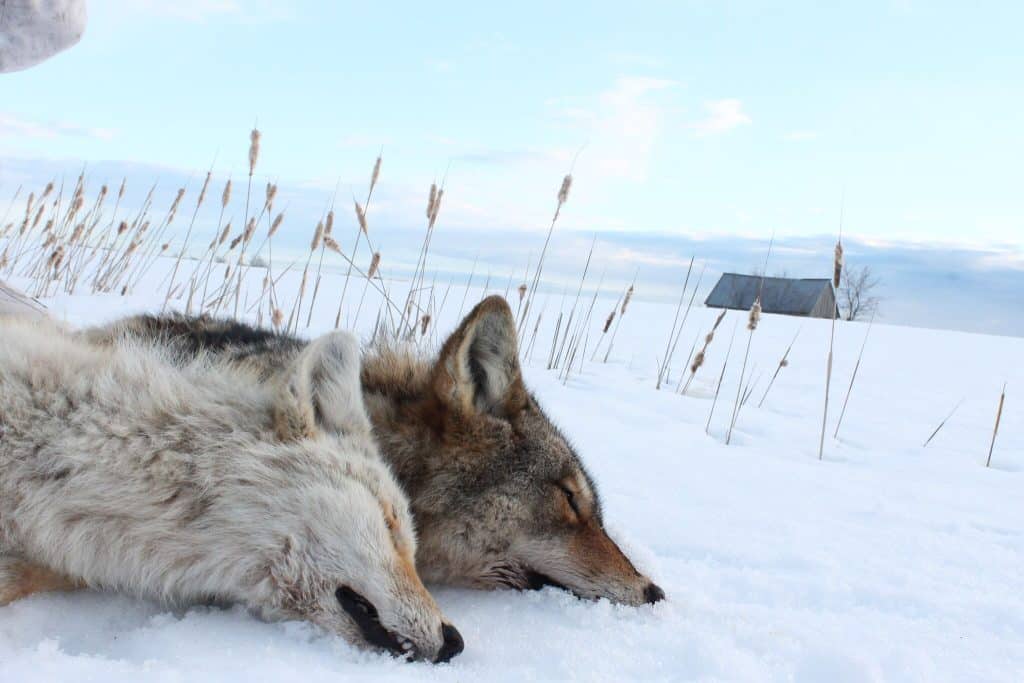
In winter, the coyote becomes more “legible”: snow reveals its movements, food becomes scarcer and activity increases around sources of prey and carrion. It’s also the period when fur is generally at its best (“prime”), which motivates many hunters and trappers.
Important: rules vary enormously by province/state (hunting hours, night hunting, use of lights, electronic calls, etc.). Before applying any technique, always check local regulations.
Table of contents
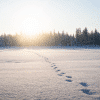
1) Snow transforms the terrain into “proof”. On bare ground, a coyote can cross an area without leaving many clues. In the snow, the trail tells the story: direction, pace (trot, walk, run), hesitations, stops, digging sites, and even the use of hard paths (trails, logging roads) to save energy.
2) Fur is often at its peak. In many parts of Canada, trapping resources indicate that the coyote’s coat is generally “prime” from late November to February (depending on latitude and conditions). This corresponds to a denser coat and a better-finished skin for the fur.
3) Feeding pressure + breeding season. In late winter (often January to March), the breeding season brings an increase in movements, vocalizations and certain territorial behaviors. It’s not a magic formula, but it helps to understand why certain areas suddenly “light up”.
For identification, think in 3 layers: size, shape and movement pattern.
Many guides give a coyote print around 2.5 to 3.5 inches long (≈ 6.4 to 8.9 cm) depending on the individual, region and snow texture. The print shows 4 fingers with visible claws. It is often more oval/elongated than that of many domestic dogs.
The coyote often moves at an economical trot. In this case, the hind leg sits almost exactly in the footprint of the front leg: this is called a direct register. The result: a cleaner, more aligned track, less erratic than many dogs.
Field tip (clean and unobtrusive): if you want to understand the area without pushing the coyote, follow the track backwards to locate the daytime rest areas, then backtrack and plan your posts on the periphery.
In North America, the coyote is often described as mainly nocturnal, but with a very flexible rhythm: it can be observed during the day, especially in rural areas or when human pressure is low. Many park resources indicate a predominantly nocturnal activity, while noting that it can come out at any time.
A useful point of reference for hunters: activity often increases during twilight periods (dawn and sunset), and extends into the evening/night, depending on the area. In practice, to stay within a simple legal framework, many hunters target light windows (pre-dawn and end of day) where permitted, rather than relying on nocturnal strategies that may be regulated.
Howling and barking serve to maintain cohesion, delimit territory and locate each other. In late winter, pair/territory dynamics can intensify these exchanges.
In Atlantic Canada, national park pages describe an opportunistic diet dominated by prey such as snowshoe hare, white-tailed deer and rodents. Other ecological studies also show that, depending on the region and the winter, the coyote may increase its use of large carcasses (carrion) when they are available.
In winter, look for places where coyotes save energy and increase their chances of finding food:
Key point: rather than “guessing”, let the snow do the talking: you choose positions where the tracks show a repetition (same lines, same crossings, same direction day after day).
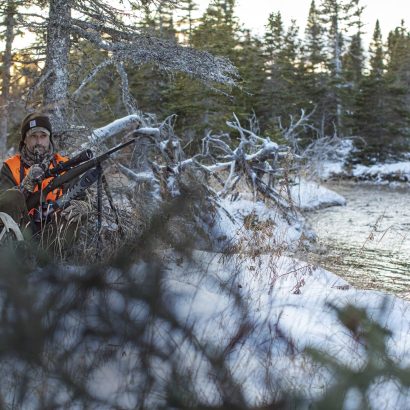
Winter coyote stalking is based on 4 variables: wind, silhouette, angle and post rotation.
The coyote is quick to detect a “bad wind”. Approach and stand upwind or crosswind to limit the scent carried to the finish chute.
A very practical approach: 20 to 45 minutes per station, then move to another area (e.g. 600 to 1000 m or more depending on the terrain). The aim is to remain mobile, without overworking a single spot.
Coyote shooting is often short-window shooting. The cold adds 3 difficulties: dexterity, fogging/condensation and mobility (thick clothing).
Note on calibers: weapon/caliber choices depend on local regulations, distance, and fur management. If you’re aiming for fur conservation, choose a known configuration to limit damage, and always validate legal compliance (ammunition, season, zones, etc.).
| Criteria | Coyote | Domestic dog (often) |
|---|---|---|
| Shape | More oval/elongated | Often rounder/variable |
| Track alignment | Very “in line” at the trot | more erratic, often zigzagging |
| Pattern | Direct register (back to front) | Less regular layering |
| Size (order of magnitude) | ≈ 6 to 9 cm (variable) | Highly variable according to breed |
| Period | What coyotes often do | What you do (field) |
|---|---|---|
| Pre-dawn / dawn | Movements, hunting returns | Early shift, controlled wind, corridors |
| Middle of the day | Rest / short trips (variable) | Track-spotting, shift planning |
| End of day / twilight | Exits to feeding areas | 20-45 min stalking on intersections |
| Marking | Value / indication | Why it’s useful |
|---|---|---|
| Prime coat (e.g. Ontario, fur resource) | Often late November → February | Fur quality + active winter period |
| Breeding season (general NA) | Often January → March (variable peak) | Understand movements / vocalizations |
| Winter density (e.g. JSTOR study) | ≈ 4.3 to 13.9 coyotes / 100 km² | Realistic: some areas are “empty”. |
How can you be sure it’s a coyote track and not a dog track?
Look at the pattern: when trotting, the coyote often does a “direct register” and the track is more aligned. The dog’s trajectory is often more irregular.
When do coyotes move the most?
Often around low-light periods (dawn/end of day) and at night, depending on human pressure. In practice, focus on legal light windows in your area.
Why does winter help so much?
Snow makes movement visible, and coyotes optimize their routes to feeding areas. This makes corridors easier to find.
Which sectors offer the best chances in winter?
Road/trail intersections, field edges, clearings, recent cuttings, and areas where prey concentrates (hare/squirrels, legally authorized carcasses).
How to avoid “burning” a job?
Controlled wind, broken silhouette, discreet approach, and rotation of positions (20-45 min). If the tracks go around your lookout, adjust wind/position.
Thank you for taking the time to read us! Have a question? An idea? A hunting story to share? Write to us at: info@recalldesigns.com.
Follow us on Facebook or Instagram. You’ll find our latest news. And useful tips. Images from the field. Calls to action. Everything that fuels a real passion.
Looking for the right tool? Explore the Recall Designs online store. Our expertise is just a click away. Tested products. Designed for hunters. By hunters.




Comments are closed