

Track reading: identify game age and sex
Trail reading is one of the hunter’s oldest and most rewarding skills. Long before the invention of GPS and trail cameras, hunters tracked game by reading signs left on the ground.
Knowing how to interpret tracks reveals not only the presence of game, but also its species, approximate size, probable sex, direction of travel, speed and freshness of passage.
Why playing tracks changes everything | Playing tracks
A track doesn’t just tell you that an animal has passed. It allows us to understand how the animal is moving, whether it’s moving slowly or accelerating, whether it’s following a routine towards a feeding area or heading for a resting place.
When you know how to relate the shape of the footprint to the depth, spacing and context of the terrain, you can transform a trace into usable information and avoid hunting “blind”.
Anatomy of a footprint | Track reading
Cervid footprints (moose, deer) consist of two main hooves (onglons) that form an elongated heart. Two dewclaws at the rear may mark, but only under certain conditions, notably when the ground is soft (mud, soft snow) or when the animal accelerates and “loads” the rear of the foot more.
Moose and deer: useful differences | Trail reading
In moose, a footprint over 15 centimetres long generally belongs to an adult, while in deer, a footprint over 7 centimetres long often indicates an adult. These markers gain in precision when confirmed by track width, depth and the repetition of similar tracks over several dozen meters.
Male vs. female: “probable” reading | Track reading
Male moose (bull) hooves are often wider and more rounded, while females (cow) have narrower, more pointed hooves. In deer, the buck generally has wider hooves than the doe for a similar length, but care must be taken as the ground can artificially widen the footprint.
Table: Reference sizes | Track playback
Charts are no substitute for experience, but they do speed up the learning process. The measurements below are handy reference points for distinguishing a juvenile from an adult and orienting a sex hypothesis, especially if you’re comparing several prints on comparable ground.
| Species | Fingerprint length (approx.) | Quick interpretation | Cross-referenced clues |
|---|---|---|---|
| Moose | > 15 cm: often adult 10-14 cm: young / female / hard ground |
The longer and wider the footprint, the more likely the animal is adult (and sometimes male). | Depth, track width, visible dewclaws on soft ground, rubbing/scraping nearby. |
| Deer | > 7 cm: often adult 4-6.5 cm: young / hard ground |
At similar lengths, a wider footprint more often suggests a buck than a doe. | Stride (spacing), depth, course (edges, canopy), consistency over 20-30 m. |
Tip: always measure several footprints, as a single trace can be enlarged by slipping, crusting or soft ground.

Depth, gauge and speed | Track reading
The depth of the imprint is directly related to the animal’s weight, but it also depends on the bearing capacity of the ground. A large moose bull generally digs its hooves in deeper than a cow or calf, and the regular appearance of dewclaws is often more frequent in heavy individuals.
The spacing between consecutive footprints provides information on size and gait: at a walk, the footprints are closer together and more regular, while at a trot, the spacing increases markedly.
| Index | Observation | What it suggests |
|---|---|---|
| Deep impression | Sagging edges, sometimes dewclaws | Heavy animal or soft ground: comparison over several steps becomes decisive. |
| Regular stride | Consistently spaced footprints | Quiet movement, routine, transition to feeding or resting. |
| Increasing stride | Suddenly more distant footprints | Trot or acceleration, often linked to an alert or pressure. |
| Winding path | Changes of direction, stops | Feeding, exploring, or approaching a sleeping area. |
Determining freshness | Track reading
In snow, a fresh track shows sharp, well-defined edges, whereas after a few hours, frost and wind begin to round out the contours and harden the bottom of the footprint. In mud, a fresh track shows fine detail, and water has not yet seeped through to fill the track.
On fallen leaves, the humidity under the overturned litter and the state of the droppings become very useful indicators for estimating the time elapsed.
Snow | Track playback
- Fresh: clean edges, well-cut relief.
- After a few hours: rounded edges, crust forming.
- Older: smoothed footprint, collapsed walls.
Mud and wet soil | Track reading
- Fresh: fine details visible, little oozing.
- Older: flowing contours, water present, drying.
Dead leaves and droppings | Track reading
- Leaves turned over wet underneath but dry on top: recent passage.
- Fresh droppings: shiny, moist and supple; old droppings: dull, dry and crumbly.
Moose tracks: identifying the bull
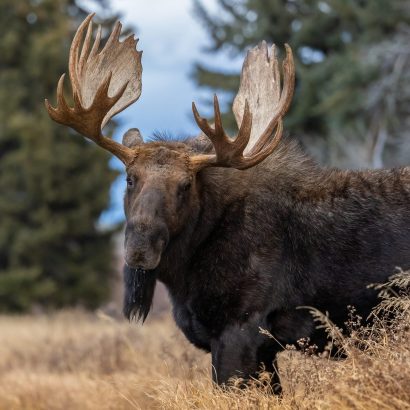
Identifying a moose bull by its tracks is a fascinating exercise for Quebec hunters. In addition to the size of the footprints, there are a number of other clues that reinforce the hypothesis of an adult bull, including the “drag mark” in the snow, the rubbed trees (rubs) and the ground scrapings (scrapes) associated with territorial marking.
| Index | Description | Field reading |
|---|---|---|
| Drag mark | Drag between steps, especially in snow | May indicate a heavy individual who lifts his leg less completely. |
| Rubs | Rubbed trees, stripped bark | The taller/intense, the more massive the individual. |
| Scrapes | Scratched area on the ground | Territorial markings typical of active periods (depending on season and context). |
Tracking movements: tracking strategy
Active tracking – following a fresh trail to the animal – is an advanced technique requiring patience, stealth and knowledge of behavior. Move slowly, observe often and watch for headwinds or crosswinds.
When the tracks indicate that the animal is slowing down, with closer footprints and a more sinuous trajectory, caution becomes essential, as it sometimes prepares to lie down at close range.
FAQ (questions and answers) | Track playback
Can we determine gender with certainty just by looking at a fingerprint?
Almost never 100%. The best approach is to combine width, depth, presence of dewclaws, track width and other clues such as rubs, scrapes, droppings and movement trajectory.
Why do my measurements vary from one print to another?
Because the ground acts like an imperfect mold. Soft snow and mud often widen the contours, while hard ground or a compact crust can reduce the trace. For a reliable reading, you need to compare several footprints over a distance of 20 to 30 meters, taking into account the same type of substrate.
Do visible ergots automatically mean a large male?
No, dewclaws are most noticeable when the ground is soft or the animal is accelerating. On the other hand, if the dewclaws appear frequently and clearly, and the track is wide and deep over a significant distance, this may reinforce the hypothesis of a heavier individual.
How to estimate the freshness of a track quickly?
In snow, sharp, well-cut edges often indicate a recent track, while rounded contours and a crust at the bottom suggest ageing. In mud, fine details and the absence of seepage point to a fresh track. On dead leaves, the moisture under the upturned leaves and the state of the droppings are very effective markers.
What indications are there that the animal is slowing down before going to bed?
Closer footprints, a winding trajectory, short changes of direction and frequent stops are classic signals. In this context, slowing down, listening and observing flats and dense cover greatly increase the chances of spotting the animal.
Thank you for taking the time to read us!
Got a question? An idea? A hunting story to tell? Write to us: info@recalldesigns.com.
Follow us on Facebook or Instagram. You’ll find our latest news. And useful tips. Images from the field. Calls to action. Everything that fuels a real passion.
Looking for the right tool? Explore the Recall Designs online store. Our expertise is just a click away, with tested products designed for hunters, by hunters.


Comments are closed