Decoys and decoys are the heart of any successful duck hunting strategy. Much more than simple plastic imitations, they are a sophisticated communication system that sends a clear message to birds in flight: “It’s safe here, there’s food and good mates.”
In autumn, when migration is in full swing in Quebec, ducks travel hundreds of kilometers every day in search of resting and feeding areas. Your decoy spread needs to replicate exactly what they’re looking for – safety, abundance and opportunity.
The difference between a hunter who returns empty-handed and one who limits his catch often lies in the quality and layout of his decoys, combined with a mastery of calling techniques. Investing in the right tools and understanding the basics will radically transform your success rate.
Ducks are social animals that travel in groups for safety. A solitary duck is vulnerable; a group of 20 ducks feeding peacefully signals the absence of predators. Your spread exploits this gregarious instinct.
Key visual signals transmitted by decoys :
Safety: A large number of relaxed decoys (various postures, some in resting position) indicates that no danger is present. Wild ducks are constantly on the alert – if they see other relaxed ducks, they lower their guard.
Feeding: Decoys in feeding position (head under water, tail up) signal a productive area. Migrating ducks actively seek out food to replenish their energy reserves.
Landing zone: A pocket of open water in the center or at the edge of your spread indicates where to land. Ducks can’t land in the middle of a tight group – they need space.
Movement: Movement attracts the eye at great distances. Static decoys go unnoticed at 500 meters; moving decoys (wings, undulations) are visible at 1 km+.
Types of ducks present: Ducks seek out their own species but like to mix. A multi-species spread (mallards, pintails, teal) appears more natural and attracts a wider range.
The market offers a dizzying array of decoys. Understanding the differences allows you to invest wisely.
| Type | Material | Durability | Realism | Best use |
|---|---|---|---|---|
| Hard plastic | Molded polyethylene | Very high (10+ years) | Low | Filler decoys, large spreads |
| Blown plastic | Hollow polyethylene | High (6-8 years) | Medium | General-purpose, standard |
| EVA foam | Compressible foam | Medium (4-6 years) | High | Easy transport, small spreads |
| Hand-painted | Various materials | Variable | Very high | Finishers, wary ducks |
| Inflatable | Reinforced vinyl | Low (2-3 years) | Medium | Minimal transport, mobility |
Essential selection criteria :
Textured matte paint: Artificial shine is the #1 flaw in cheap decoys. Live ducks have matte plumage with texture. Look for decoys with matte-finish paint and textured details.
Keel and anchoring system: Decoys with integrated weighted keel float into the correct position automatically. A central attachment point under the keel prevents the decoy from constantly turning with the wind.
Varied poses: Your collection should include at least :
Size: Magnum decoys (25-30% larger than natural size) are more visible from a distance. Full-size decoys are more natural up close. A 70% standard / 30% magnum mix works well.
| Context | Recommended number | Species ratio | Configuration | Justification |
|---|---|---|---|---|
| Early season (Sept.-Oct.) | 12-18 | 100% local species | J single | Naïve ducks, little pressure |
| Mid-season (mid-Oct-mid-Nov) | 24-36 | 70% mallard, 20% pintail, 10% teal | J double or V | Active migration, competition |
| End of season (late Nov-Dec) | 6-12 premium | 100% target species | Small groups | Educated ducks, quality > quantity |
| Small marsh (<1 ha) | 12-18 | Local mix | J or U | Proportional to water level |
| Grande baie (>5 ha) | 36-60 | Diversified mix | Multiple spreads | Long-distance visibility |
Rule of thumb: start with 24 medium-quality decoys. This is sufficient for most situations, and remains portable.
Quality vs. quantity: 12 ultra-realistic premium decoys will always beat 48 shiny cheap decoys. Educated ducks detect poor-quality imitations at 200 meters.
Fishhook formation:
The most versatile and effective. Place the long stem of the J perpendicular to the wind, with the hook forming a landing pocket facing your cache.
Configuration :
U-shaped formation (horseshoe) :
Ideal for variable or rotating winds. Creates a central landing zone accessible from 180°.
V-shape (funnel) :
Guides ducks to a precise focal point. Effective for channelling birds to your optimum shooting zone.
Pod training :
Imitates natural duck groups that separate into family subgroups. Very realistic for educated ducks.
Configuration :
Optimum distances by activity :
Professional realism tips:
Jerk cord :
The simplest and most effective system. Tie a rope to 2-3 light decoys, and pull the rope through to your cache. Pull rhythmically to create wrinkles and realistic movement.
Spinning wing decoys (mojo) :
Motorized decoy with rotating wings. Extremely visible but controversial. Activate intermittently and switch off as soon as the ducks engage.
Water wigglers :
Small motor that creates constant ripples. More subtle than the mojo, it operates continuously in the center of the landing pocket.
The voice call complements the visual decoys. A good hunter uses his voice as a persuasive tool, not as an alarm horn.
Recall Designs duck calls:
Recall Designs, North America’s leader in premium duck calls, offers a complete line of duck calls designed to maximize your fall success.
Hen Archy series:
The Hen Archy series is Recall Designs’ flagship duck hunting range. Available in three configurations:
Hen Archy Bois: Made from noble woods such as Bocote, African Blackwood or Bocote-African Blackwood, this call offers a warm, natural tone appreciated by purists. The wood produces a soft, realistic sound, ideal for educated ducks and late-season finesse situations.
Hen Archy Acrylic: Available in multiple colors (Blue, Orange, Clear, Copper, Camo Longleaf), acrylic offers superior volume and a brilliant tone that carries farther. Perfect for windy conditions and large bodies of water. The material is more resistant to humidity than wood.
Hen Archy Wood-Acrylic: A combination of noble woods (Bocote Clair, African Blackwood Clair, Pau Rosa Clair) and acrylic. This hybrid configuration offers the best of both worlds: the tonal warmth of wood with the power of acrylic.
Duck Break series:
For hunters looking for an economical call without compromising performance, the Duck Break series offers excellent value for money. Available in Single-reed (S) and Double-reed (D) models, these calls are ideal for beginners or as back-up calls.
Dead Zone Series:
The Dead Zone call in Bocote-Delrin combines aesthetics and performance. Delrin is an ultra-durable material that withstands shocks and extreme conditions, while delivering a clean, precise tone.
High and Low :
Versatile caller with two distinct tones in a single instrument. Ideal for the hunter who wants to vary his calls without carrying several calls.
LilWoodys:
Compact version in noble wood (Bocote, African Blackwood). Perfect for young hunters or as a lightweight pocket call.
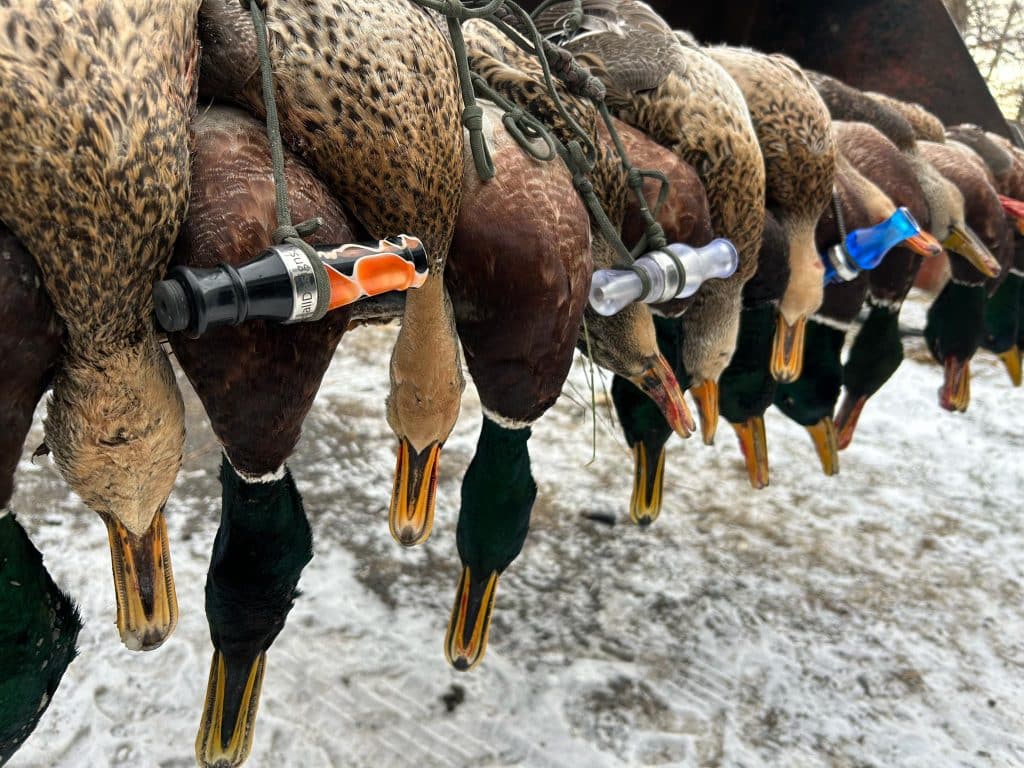
Which Recall Designs decoy to choose?
Call sequences by approach phase :
Phase 1 – Detection (400+ meters) :
Hail call: 5-7 downward quacks, maximum volume to attract attention.
Phase 2 – Engagement (200-400m) :
Greeting call and feeding chuckle: alternating to maintain interest.
Phase 3 – Final approach (50-200m) :
Contentment and feeding murmurs: soft and reassuring.
Phase 4 – Final engagement (0-50m) :
COMPLETE SILENCE or ultra-discrete whispers only.
Phase 5 – Comeback :
Aggressive series of 10-15 quick quacks if the ducks move away.
Caring for your Recall Designs call :
| Period | Duck behaviour | Number of decoys | Recall Designs | Training |
|---|---|---|---|---|
| Early Sept – early Oct | Local, naive | 12-18 | Duck Break, LilWoodys | J simple |
| Mid-Oct – early Nov | First migrants | 24-36 | Hen Archy Acrylic | J double, V |
| Mid-Nov – end of Dec | Very wary | 6-12 premium | Hen Archy Bois | Small pods |
Early season: Simple spreads, basic calls, classic J formations.
Mid-season: Increase to 24-36 decoys, sophisticated formations, varied calls with volume.
End of season: Reduce to 6-12 ultra-realistic decoys, minimalist calls with natural tone, “less is more”.
Cleaning during the season :
Off-season storage :
Start with 12-18 medium-quality decoys. This is enough to learn and covers 80% of situations.
The J formation (fishhook) is the most versatile and effective for 90% of situations.
Duck Break or LilWoodys are perfect for beginners – economical, easy to blow and high-performance. For a more serious investment, the Hen Archy Acrylic offers versatility and durability.
The main landing pocket should be 15-25 meters from your position.
Effective in early and mid-season, but use sparingly. Switch off as soon as the ducks start to move in.
Visit the Recall Designs sound library (www.recalldesigns.com/bibliotheque-de-sons) to hear professional footage. Practice regularly and hunt with an experienced caller.
Thank you for taking the time to read us! Have a question? An idea? A hunting story to share? Write to us at: info@recalldesigns.com.
Follow us on Facebook or Instagram. You’ll find our latest news. And useful tips. Images from the field. Calls to action. Everything that fuels a real passion.
Looking for the right tool? Explore the Recall Designs online store. Our expertise is just a click away. Tested products. Designed for hunters. By hunters.






Comments are closed