The Canada goose is one of Quebec’s most prized migratory game birds. This remarkably intelligent bird has an exceptional spatial memory and follows predictable routines that, once decoded, transform the patient hunter into a formidable strategist.
Unlike ducks, which explore new areas on a daily basis, bustards remain faithful to their favorite feeding grounds for weeks on end, as long as food is plentiful. This territorial loyalty makes scouting your best ally: a well-invested afternoon of observation often guarantees a memorable hunt the next day.
Mastering the art of reading bustard flights requires patience, observation and an understanding of their social behavior. This guide teaches you how to decode their movements, identify their critical zones and position yourself strategically to maximize your chances of success.
Social structure and loyalty :
Bustards live in close-knit family units made up of the parents and their young of the year. These families remain together throughout the goslings’ first year. Several families gather in flocks of 20 to 200 birds to migrate and feed.
This hierarchical social structure influences their movements. Dominant families occupy the best sections of the feeding grounds, while younger and less experienced groups make do with the outlying areas.
Memory and learning :
Bustards have a remarkable spatial memory. They precisely memorize the location of productive fields, sources of danger and safest routes. A bustard that survives a hunting season will return the following year with a heightened distrust of caches and decoys.
Site loyalty:
Once a flock of bustards adopts a field, they will return daily as long as food remains plentiful and no major danger is perceived. This loyalty can last 3 to 6 weeks in autumn, until the field is exhausted or winter conditions push them further south.
Voice communication :
Bustards communicate constantly in flight. The famous “honk-honk” is used to maintain group cohesion, signal feeding areas and warn of danger. Understanding these vocalizations helps you anticipate their intentions.
Flight corridors are the aerial highways that bustards use every day between their three vital zones: dormitory (night), rest (mid-day) and feeding (morning/evening).
Spotting methodology :
Day 1 – Evening observation (4pm-7pm) :
Position yourself on a high point with a panoramic view. Bring 10×42 binoculars, a topographical map or GPS, and a notebook.
For each flight observed, note :
Day 2 – Morning observation :
Repeat the process at dawn. Morning corridors are often identical to evening corridors, but in reverse.
Day 3 – Confirmation :
Check the consistency of the patterns. If the weather changes (wind shifts), the corridors may shift slightly.
| Type of flight | Altitude | Distance | Time | Huntable |
|---|---|---|---|---|
| Dormitory → Power supply | 30-100m | 2-15 km | Sunrise +20-40 min | Yes (excellent) |
| Power supply → Rest | 50-150m | 1-5 km | 10am-12pm | Medium |
| Rest → Power supply | 40-120m | 1-5 km | 14h-16h | Yes (good) |
| Power supply → Dormitory | 50-150m | 2-15 km | 5pm-7pm | Difficult |
| Long-distance migration | 300-1500m | 50-500 km | Variable | No |
Factors influencing corridors :
Wind : Bustards prefer to fly upwind or crosswind. A strong wind alters their trajectory by 15-30° to compensate for drift.
Obstacles: Bustards avoid dense forests, high power lines and urban areas. They bypass these obstacles using predictable routes.
Topography: They often follow river valleys, ridgelines and natural corridors that provide visual landmarks.
Food preferences by period :
September – early October :
Mid-October – November :
Field spotting techniques :
Method 1 – Road reconnaissance (4pm-6:30pm) :
Drive along rural roads in the late afternoon. Bustards can be seen several kilometers away in open fields. When you spot a group, don’t stop immediately. Continue for 500 meters, turn around, and observe from the vehicle with binoculars.
Method 2 – Morning observation of dormitories :
Position yourself near a large body of water at sunrise. Observe the direction of departure of the first groups.
Method 3 – Collaboration with farmers :
Farmers know exactly which fields are frequented. A friendly conversation and a request for permission often reveal valuable information.
| Field type | Attractiveness | Duration of use | Number of bustards | Difficulty |
|---|---|---|---|---|
| Recently harvested grain corn | Excellent | 4-6 weeks old | 200-1000+ | Medium |
| Old grain corn | Bonne | 2-3 weeks | 50-300 | Easy |
| Green pasture | Very good | Full season | 100-500 | Difficult (little camouflage) |
| Harvested soybeans | Average | 1-2 weeks | 50-200 | Average |
| Winter wheat sown | Good | 3-4 weeks | 100-400 | Easy |
Positioning principle :
Like all birds, bustards ALWAYS land into the wind. They first fly over the field at 50-100 meters to assess safety, then turn into the wind and spiral down towards the feeding area.
Optimum configuration :
Place your spread of decoys exactly where the bustards were feeding the day before. If they occupied the northeast corner, set up there. Don’t try to “move” the bustards to another area.
| Context | Number of decoys | Type | Training | Justification |
|---|---|---|---|---|
| Early season (Sept) | 50-100 | Shells or silhouettes | Scattered groups | Unsuspecting bustards |
| Mid-season (Oct-early Nov) | 100-200 | Premium shells | Distinct families | Maximum competition |
| End of season (late Nov-Dec) | 30-80 | High-end shells | Natural, spaced | Highly educated bustards |
| Small field (<5 ha) | 50-100 | Mix | Proportional | Avoiding overcrowding |
| Large field (>10 ha) | 150-300 | Shells | Multiple spreads | Long-distance visibility |
Training for effective decoys :
Family training (the most natural) :
Create 8-12 family groups of 6-10 decoys each. Space the groups 10-15 meters apart. Within each group, the decoys are 60-120 cm apart. Orient each family in a different direction.
Landing zone :
Leave a 15-20 metre diameter pocket WITHOUT decoys, 20-30 metres downwind of your cache. This is where the bustards will want to land.
Types of caches :
Cache camouflage :
A typical hunting day :
Influence of weather :
Overcast + moderate wind (15-25 km/h): IDEAL CONDITIONS
Recent cold front (24-48h): EXCEPTIONAL
Recall Designs bustard calls:
Recall Designs offers a complete line of specialized bustard calls, designed to faithfully reproduce the complex vocalizations of the Canada goose.
Series The One Acrylic :
Recall Designs’ flagship bustard call. Available in multiple colors (Ruby Red, Blue, Black, etc.), The One Acrylic offers exceptional volume and a penetrating tone that carries for hundreds of meters. Acrylic stands up perfectly to morning humidity and cold autumn temperatures.
Ideal for hailing and windy situations. The resonance of the acrylic perfectly reproduces the characteristic “honk” of the bustard.
Dead Zone Series Outarde :
Premium decoy combining performance and durability. Designed specifically for serious hunters who demand consistency and reliability. Excellent sound projection while maintaining precise control for finesse calls.
Goose Break:
Economical call perfect for beginners or as a back-up call. Offers solid sound quality at unbeatable value. Easy to blow, forgiving of technical errors by less experienced callers.
Which Recall Designs bustard call to choose?
Bustard vocalizations and their use :
1. Cluck (basic contact sound) :
Short, nasal sound: “honk”. Use 2-3 clucks spaced every 15-20 seconds when bustards are approaching from a medium distance (200-500m).
2. Double cluck (excitation) :
Two quick clucks: “honk-honk”. Use when a group shows interest but seems hesitant.
3. Hail call :
Series of 5-10 strong, descending clucks: “HONK-honk-honk-honk-honk-honk”. Gate at 1+ km. Use on bustards at 500+ meters who pass by without looking at your field.
4. Murmur / Feed call :
Rapid series of low, soft sounds: “urr-urr-urr-urr-urr”. Use when bustards are on final approach (50-200m) and assessing your spread.
5. Moan (long moan):
Long, plaintive sound: “honnnnnnnnk”. Use sporadically mixed with clucks for added realism.
Typical call sequence :
Phase 1 – Bustards at 1+ km :
Aggressive hail call: 7-10 strong clucks, repeat every 20-30 seconds until reaction. Volume 100%.
Phase 2 – Bustards at 400-800m :
Series of moderate clucks: 3-5 medium-volume clucks, spaced apart. Volume 60-70%.
Phase 3 – Bustards at 200-400m :
Soft clucks + murmurs: 2-3 clucks followed by feed call. Volume 40-50%.
Phase 4 – Bustards at 50-200m :
Almost constant murmurs + occasional moans. Volume 20-30%.
Phase 5 – Bustards at 0-50m :
COMPLETE SILENCE or ultra-discrete murmurs only.
Flagging (complementary technique) :
Flagging consists of waving a black flag mounted on a 2-3 metre pole. The movement imitates the wings of a bustard as it lands, attracting attention from a great distance (1-2 km).
Caring for your Recall Designs call :
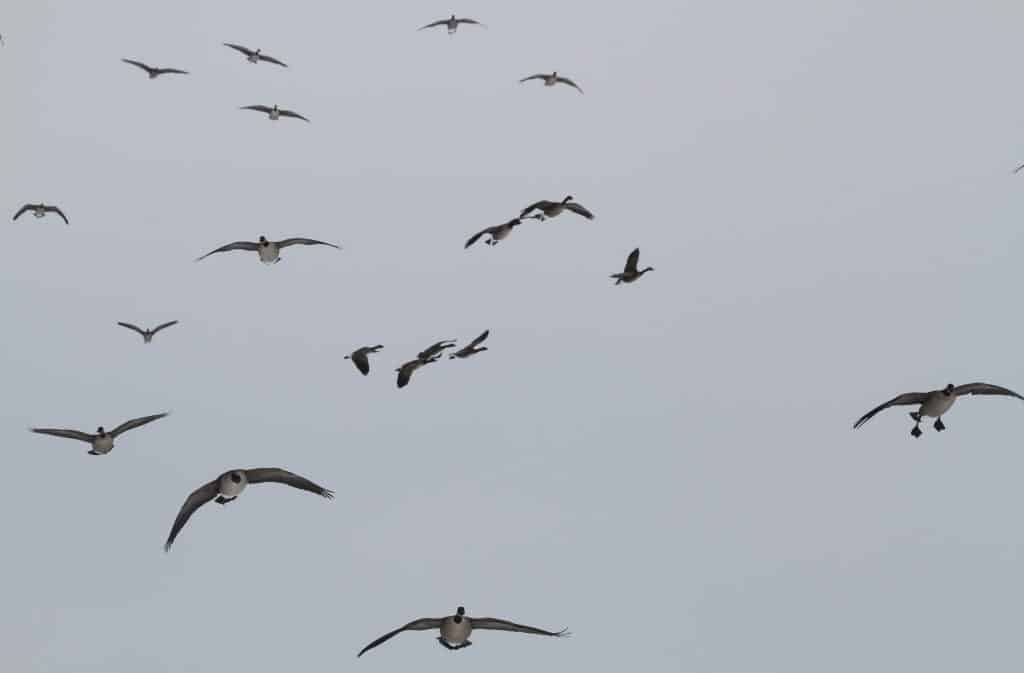
Visual signals indicating engagement :
Positive commitment :
Hesitation/evaluation :
Action: Increase calls, add movement (flagging), stand still.
Rejection/leakage :
Positive identification :
Before shooting, confirm 100% that you are targeting Canada geese and not :
Shooting distance :
Maximum 45 meters with BB or #2 steel. Prefer 30-40 meters to ensure an ethical kill. Bustards are tough – a misplaced shot at 50+ meters will wound without killing.
Recovery :
A trained retriever dog is highly recommended. Injured bustards can run for hundreds of meters in cornfields.
Minimum 2 days’ observation to identify flight corridors and confirm feeding grounds. Ideally 3-4 days to ensure consistent patterns.
Family formation (groups of 6-10 decoys spaced 10-15m apart) is the most natural and effective. Avoid straight lines or perfect circles.
The Goose Break is perfect for beginners – economical, easy to blow, reliable performance. For a more serious investment, The One Acrylic offers exceptional volume and versatility.
The landing zone (decoy-free pocket) should be 20-30 meters downwind of your cache. Decoys surround this area.
If you haven’t alarmed them too much, they may return the same day. They usually return to the same field the next day, but with increased suspicion.
Approach the owner in person, be courteous and professional, offer to share the harvest, and scrupulously respect fences and crops.
Thank you for taking the time to read us! Have a question? An idea? A hunting story to share? Write to us at: info@recalldesigns.com.
Follow us on Facebook or Instagram. You’ll find our latest news. And useful tips. Images from the field. Calls to action. Everything that fuels a real passion.
Looking for the right tool? Explore the Recall Designs online store. Our expertise is just a click away. Tested products. Designed for hunters. By hunters.







Comments are closed